G R Santosh, widely acclaimed painter and poet, was born in 1929. He was born Ghulam Rasool Dar in a Kashmiri Muslim family of modest means. He dropped out of school after his father's death and took up menial jobs. He drew landscapes and sketches
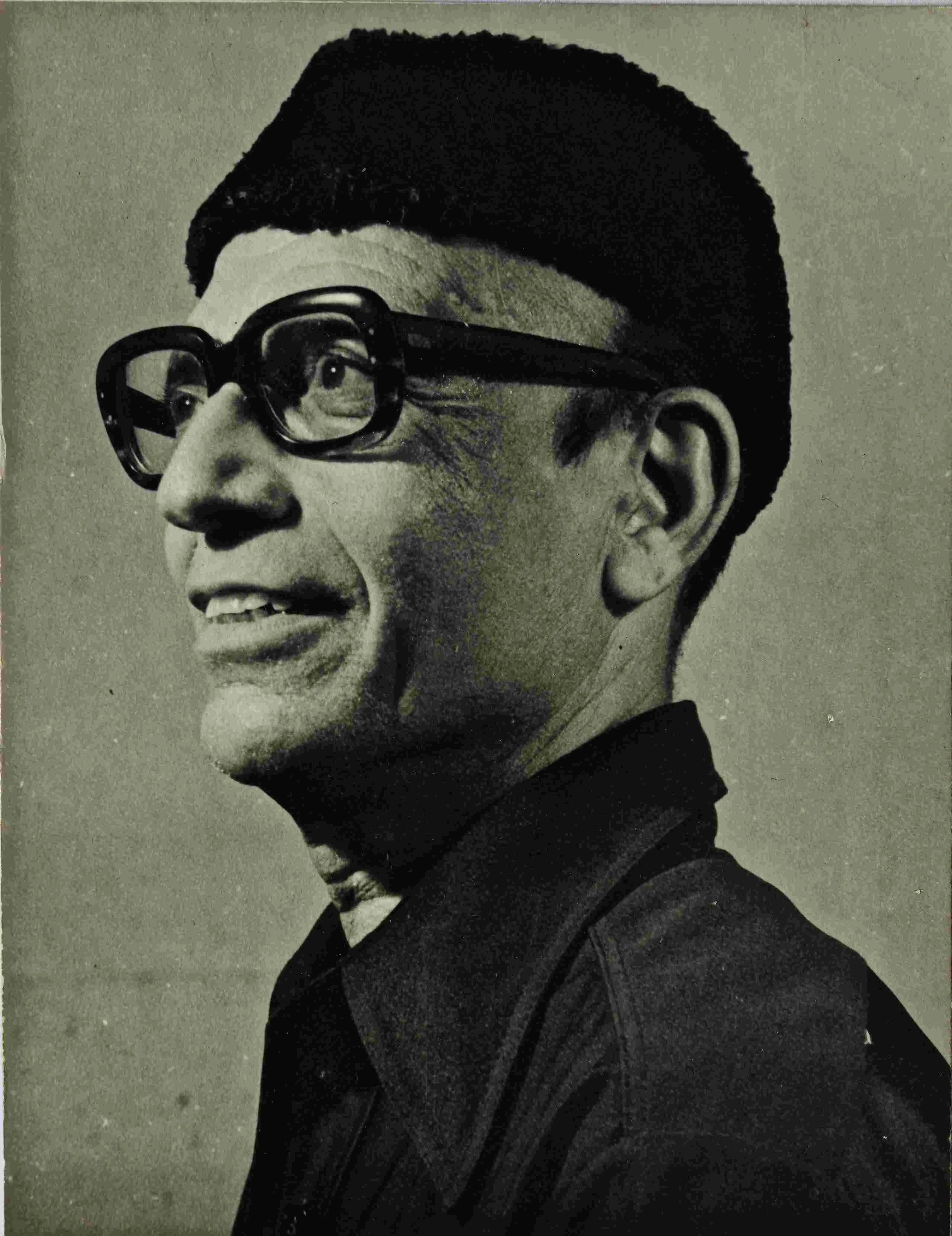
G R Santosh, widely acclaimed painter and poet, was born in 1929. He was born Ghulam Rasool Dar in a Kashmiri Muslim family of modest means. He dropped out of school after his father's death and took up menial jobs. He drew landscapes and sketches in this period, arguably by drawing inspiration from his late artist grandfather.
In 1950, Santosh joined the Progressive Arts Association in Kashmir, formed as a result of artist S H Raza's efforts to mobilise Kashmiri painters. Santosh exhibited across India as a member of this association. In 1954, he won the government scholarship to study Fine Arts under the guidance of artist N S Bendre at the MS University, Baroda. During that time, he did something revolutionary for Kashmiri society, by marrying his childhood lover, Santosh, who was a Kashmiri Pandit. Further he assumed her name, and became Ghulam Rasool Santosh.
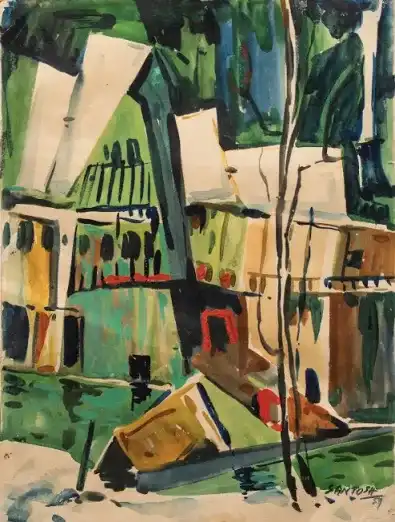
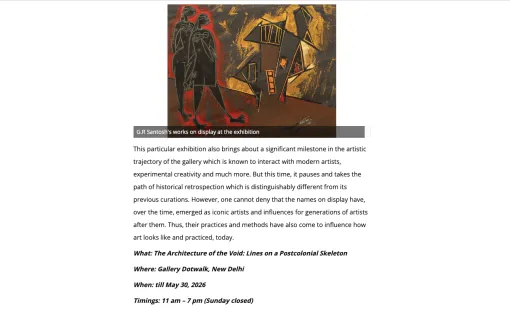
In his early years, Santosh was greatly influenced by geometric shapes and the mysticism of the Kashmir valley. His treatment of snow-clad houses and the backwaters on the banks of river Jhelum reveals his finely tuned sense of visual perception and is an example of splendid semi-abstract treatment. Although Santosh began by painting landscapes, he was gradually influenced by Cubism and switched over to creating Cubist landscapes, a theme that became popular later.
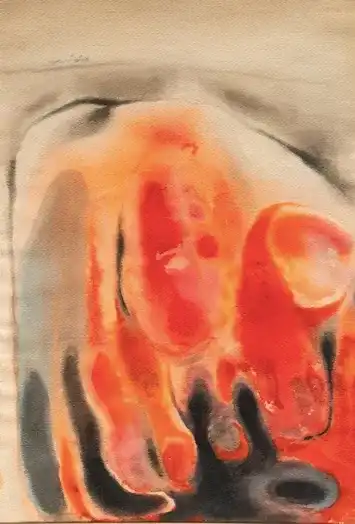
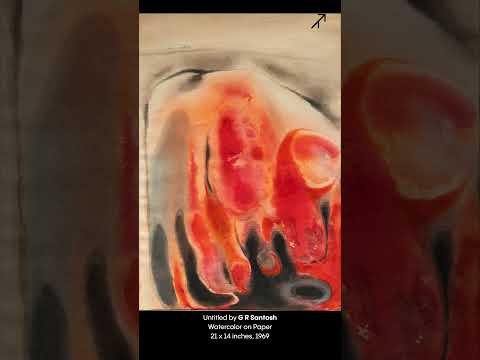
Inspired by the Tantra philosophy, he combined the male and female forms, and finally worked round to paint a pure image of the human form, leaving out the face, hands and feet. For a while, therefore, his subjects came to be dominated by the Shiv-Shakti. His ‘luminous’ colour application and transcendent imagery paved the way for some stunning artworks around the same theme.
In 1973, he received the Lalit Kala Akademi award and the Padma Shri in 1977. In 1979, he became the recipient of Sahitya Akademi Award for his poem titled Be Soakh Rooh. The artist passed away in 1997 in New Delhi.
Academics
Faculty of Fine Arts, Maharaja Sayajirao University of Baroda.(Student of N. S. Bendre) 1954-56. Self-Taught Craftsman, Painter, Weaver. 947-53
Awards
Doctorate of Literature (LittD), posthumous, by University of Jammu 1997
Posthumous citation and special prize for 'extraordinary contribution in the field of Art and Literature', by the Government of Jammu and Kashmir 1997
Zehne Jadid Aitraaf for best interview published in the Urdu magazine Zehne Jadid 1992
Kala Ratna Award, All India Fine Arts and Crafts Society (AIFACS), New Delhi 1991
Kalhana Award, The Kashmir Education and Science Society, New Delhi 1985
Artist of the Year, Sahitya Kala Parishad, New Delhi 1984
Sahitya Akademi Award for Besukh Ruh (his collection of poems) 1979
Awarded Padmashri, Government of India 1977
National Award, Lalit Kala Akademi, New Delhi 1973
National Award, Lalit Kala Akademi, New Delhi 1964
First Prize, Kalidasa Jayanti Exhibition 1959
National Award, Lalit Kala Akademi, New Delhi 1957
G R Santosh, widely acclaimed painter and poet, was born in 1929. He was born Ghulam Rasool Dar in a Kashmiri Muslim family of modest means. He dropped out of school after his father's death and took up menial jobs. He drew landscapes and sketches in this period, arguably by drawing inspiration
G R Santosh, widely acclaimed painter and poet, was born in 1929. He was born Ghulam Rasool Dar in a Kashmiri Muslim family of modest means. He dropped out of school after his father's death and took up menial jobs. He drew landscapes and sketches in this period, arguably by drawing inspiration from his late artist grandfather.
In 1950, Santosh joined the Progressive Arts Association in Kashmir, formed as a result of artist S H Raza's efforts to mobilise Kashmiri painters. Santosh exhibited across India as a member of this association. In 1954, he won the government scholarship to study Fine Arts under the guidance of artist N S Bendre at the MS University, Baroda. During that time, he did something revolutionary for Kashmiri society, by marrying his childhood lover, Santosh, who was a Kashmiri Pandit. Further he assumed her name, and became Ghulam Rasool Santosh.
In his early years, Santosh was greatly influenced by geometric shapes and the mysticism of the Kashmir valley. His treatment of snow-clad houses and the backwaters on the banks of river Jhelum reveals his finely tuned sense of visual perception and is an example of splendid semi-abstract treatment. Although Santosh began by painting landscapes, he was gradually influenced by Cubism and switched over to creating Cubist landscapes, a theme that became popular later.
Inspired by the Tantra philosophy, he combined the male and female forms, and finally worked round to paint a pure image of the human form, leaving out the face, hands and feet. For a while, therefore, his subjects came to be dominated by the Shiv-Shakti. His ‘luminous’ colour application and transcendent imagery paved the way for some stunning artworks around the same theme.
In 1973, he received the Lalit Kala Akademi award and the Padma Shri in 1977. In 1979, he became the recipient of Sahitya Akademi Award for his poem titled Be Soakh Rooh. The artist passed away in 1997 in New Delhi.
Academics
Faculty of Fine Arts, Maharaja Sayajirao University of Baroda.(Student of N. S. Bendre) 1954-56. Self-Taught Craftsman, Painter, Weaver. 947-53
Awards
Doctorate of Literature (LittD), posthumous, by University of Jammu 1997
Posthumous citation and special prize for 'extraordinary contribution in the field of Art and Literature', by the Government of Jammu and Kashmir 1997
Zehne Jadid Aitraaf for best interview published in the Urdu magazine Zehne Jadid 1992
Kala Ratna Award, All India Fine Arts and Crafts Society (AIFACS), New Delhi 1991
Kalhana Award, The Kashmir Education and Science Society, New Delhi 1985
Artist of the Year, Sahitya Kala Parishad, New Delhi 1984
Sahitya Akademi Award for Besukh Ruh (his collection of poems) 1979
Awarded Padmashri, Government of India 1977
National Award, Lalit Kala Akademi, New Delhi 1973
National Award, Lalit Kala Akademi, New Delhi 1964
First Prize, Kalidasa Jayanti Exhibition 1959
National Award, Lalit Kala Akademi, New Delhi 1957
Governor of Bombay’s Prize 1955-56
Cultural Scholarship, Government of India 1954-56
Exhibitions
Solo Exhibitions:
Dhoomimal Art Centre, New Delhi 1994
Little Theatre Gallery, New Delhi 1991
Jehangir Art Gallery, Mumbai 1989
Dhoomimal Art Centre, New Delhi 1985
'Santosh', Gallery TAI IN, Seoul 1983
'Modern Indian Paintings', Hirschhorn Museum and Sculpture Garden, Washington D.C.,USA 1982
'Contemporary Indian Art', Festival of India, Royal Academy of Art, London 1982
'Contemporary Indian Art', organized by National Gallery of Modern Art (NGMA) at Japan 1979-80
Exhibition at South Korea 1978
Triveni Kala Sangam, Gallery Chanakya, New Delhi 1978
South Korea 1976
‘Acrylics’, Gallery Chanakya, New Delhi 1976
‘Pencil Drawings’, Gallery Chanakya, New Delhi 1975
Exhibition dedicated to Urdu Writer Thakur Poonchi, Srinagar 1974
Gallery Chanakya, New Delhi 1973
Gallery Chanakya, New Delhi 1970
Bistidari, New Delhi 1970
Pundole Art Gallery, Mumbai 1969
Dhoomimal Art Centre, New Delhi 1968
Gallery Chemould, Mumbai 1968
Kunika Chemould Art Centre, New Delhi 1967
Revel Gallery, New York 1964
Gallery Mayer, New York, Kumar Gallery, Kolkata, Kabul, Tel Aviv, Los Angeles, Devorah Sherman Gallery, Chicago 1962
,71 Kumar Gallery, New Delhi 1962
,57,59,62,64 Mumbai 1953
-56,63 Srinagar 1953
Group Exhibitions:
Jehangir Art Gallery, Mumbai 1992
'Exhibition of Contemporary Indian Painters', National Gallery of Modern Art (NGMA), New Delhi 1984
'Neo-Tantra', National Gallery of Modern Art (NGMA), New Delhi and Sahitya Kala Parishad, New Delhi 1984
'Tantra', Stuttgart, West Germany and South Korea 1983
Paintings in the Miniature format, Lalit Kala Akademi, New Delhi 1980
'Contemporary Indian Art', National Gallery of Modern Art at Japan 1979-80
'Contemparary Indian Painting', Washington D.C. 1973
Cannes, France 1972
'Contemporary Indian Painting', GDR (German Democratic Republic) 1972
Exhibition at Los Angeles, U.S.A. 1971
'Tantra Art', Montreal 1971
'Contemporary Art of India', Japan 1971
'Ten Contemporary Painters', M.LT. Cambridge and New Jersey State Museum 1965
'Ten Contemporary Painters from India', University of South Florida, Tampa 1963-64
Museum of Contemporary Art, Jacksonville 1963-64
Delgado Museum of Art (New Orleans Museum of Art), New Orleans 1963-64
Hunter Gallery of Art, Chattanooga, Colorado Springs 1963-64
Long Beach Art Centre, San Francisco, East-West Centre, Honolulu and continued in Hong Kong, Manila and Singapore 1963-64